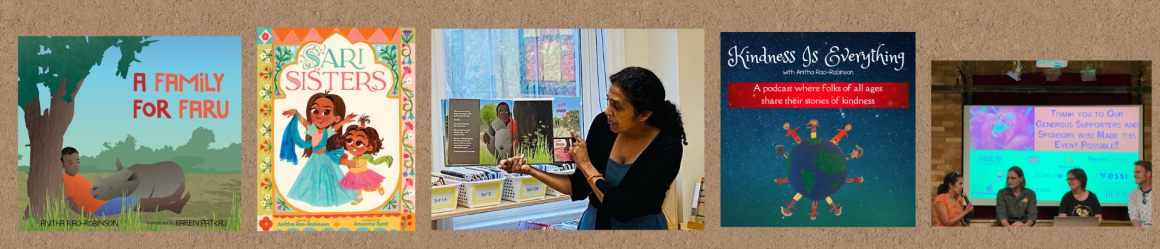
High school senior, Vini Possobom, joins me to talk about the many initiatives and causes he’s involved in that help others.
From raising funds to reunite a young boy with his parents, to volunteering with a non-profit organization called Robotics For All— Vini is dedicated to doing whatever he can to help as many people as possible.
He manages to do all of this while keeping on top of his own school work, university applications, and participating in activities like basketball, choir, band and the drama club.
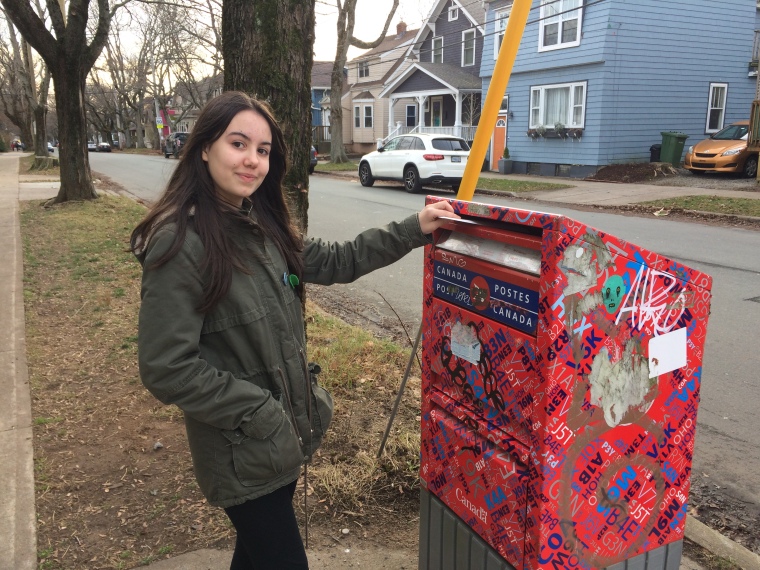
Amelia mailing one of her 53 letters to Prime MinisterJustin Trudeau,
Fifteen-year-old writer and climate change activist, Amelia Penney-Crocker, joins me to talk about her dedication to climate change.
In December of 2019, Amelia embarked on an ambitious journey of writing one letter every week, for 53 weeks, to Prime Minister, Justin Trudeau. Amelia shares her goals, frustrations, as well as her reasons for optimism.
To read all of Amelia’s letters to the Prime Minister, please go to her website. You will be so impressed and inspired by all she does to help our planet. https://ameliapenneycrocker.com/
This episode was produced by Stephen Hurley of VoicEd Radio.
On this episode, I speak with eleven-year-old Sid Chaurasia. Sid shares her story of being part of the Terry Fox Run at school when she noticed a younger student off to the side. At the time, only seven herself, Sid stopped to find out why the little boy wasn’t running with everyone else. When she learned of his dilemma, Sid helped him with the issue and then together they finished the run.
Sid acted without any expectation of acknowledgment or reward, but her act of kindness was noticed and she was surprised at the outcome.
As a thank you for sharing her story of kindness, I donated to the SickKids Foundation on behalf of Sid.
For more information about The Terry Fox Foundation and how you can help, please click on this link: https://terryfox.org/run/
Ten-year-olds Maya and Liberty Persaud join me to share not one, but two stories of kindness.
Moving to a new country can be exciting, but it also brings on the challenge of making friends. Maya and Liberty Persaud have a lot of experience with this. When the girls were four years old, they moved from Canada to South Korea, and then at the age of eight, they moved to Brazil. Each move meant a new school, new friends, and a new language.
Familiar with being the ‘new kid’ at school and how that can often make someone feel left out, Maya and Liberty created a Buddy Bench.
This wonderful bench is there for any child who is feeling lonely. The child sits on the bench to signal they need someone to play with. Once other children see that student at the bench, they can invite him or her to be a part of their game and feel included. How lovely!
Maya & Liberty and their Buddy Bench
The girls’ acts of kindness didn’t end with the Buddy Bench. They also share their involvement with Nyaka Orphanage, an organization that supports the needs of orphaned and vulnerable children in rural southwestern Uganda.
As a thank you for sharing their story of kindness, I donated to the Nyaka Orphanage on behalf of Maya and Liberty.
For more information about the Nyaka Orphange, please check out their website: https://nyakaglobal.org/
This episode was produced by Stephen Hurley of VoicEd Radio.
Almost five years ago, a wonderful thing happened—Poppy joined our family. Not only did we gain an adorable dog, but we also joined an amazing community— the Fetch & Releash dog rescue. Through this incredible group, we get support, advice, and what I most love, hearing inspiring stories from other adopters. One such story came from Chanelle Singer.
Chanelle grew up with dogs and cats, and has always been drawn to animals. She says,“Animals have such beautiful energies and are so loving.”
In 2013, she moved out on her own and adopted Tizrah, a cat. At the time the vet thought Tizrah might be nine years old, but they were unsure as to her exact age, because Tizrah had lost most of her teeth.
The incomparable, Tizrah!
2020 was an eventful year for Chanelle, and not just because of the world-wide pandemic. Chanelle got married in September and a ten-year old Pitbull Mastiff joined their family.
Kirby belonged to a neighbour who could no longer care for him. Chanelle and her husband, Justin, had been thinking about adopting a senior dog, because it’s often difficult to find homes for older dogs. They had gotten to know Kirby for about a year and found him to be a sweet and friendly dog. So, when they heard about their neighbour’s dilemma, Chanelle and Justin stepped in and adopted Kirby.
Chanelle & Justin
Unlike Chanelle and Justin, Tizrah was not as happy about the new addition to the family. Although Kirby had many many pounds on her, Tizrah made it clear she ran the house. When they first met, she gave Kirby a warning swat and that was it. Kirby quickly realized his place. Whenever Tizrah entered the room, no matter where he was, Kirby would move to give her a clear path.
Sadly, Chanelle and Justin had less than six months with Kirby. Unbeknownst to them, Kirby had a tumor and passed away.
Sweet Kirby
Though the experience of adopting a senior dog left Chanelle and Justin heartbroken, it didn’t sway them from their decision to continue adopting senior dogs. They wanted to give a dog the best life possible for however long the dog had.
When they were once again ready to welcome a dog into their home, Chanelle found Leo on Pet Finder. As soon as she saw his picture and read his profile, she decided, ‘That’s my dog!’
Leo’s Profile Picture
Originally, from India, poor Leo had been hit by a train. Miraculously, he survived, though the accident left him without a front left leg and back left paw.
Fetch & Releash heard about Leo and decided to rescue him. He was supposed to arrive in Canada in March of 2020, but the pandemic delayed his arrival until September.
Chanelle and Justin were a bit nervous about taking on a special needs dog, but decided they were up for the challenge.
The adoption process took about a month. One of the things I love about Fetch & Releash is their commitment to ensuring that each of their dogs is placed in the right home. They screen potential adopters to make sure they can provide for the dog’s emotional, physical and financial needs.
In November, Chanelle and Justin were approved to adopt Leo and right away they began prepping for his arrival. They installed carpeting over all the floors, because understandably, Leo is afraid of floors. They also made sure to block off all the stairs.
When Leo first arrived, he was nervous and stayed in his bed. He did welcome pets and belly rubs. But after two weeks, Leo was joining in the family cuddles.
Chanelle and Justin are learning what it takes to be a parent of a special needs dog. Having only two legs affects not just Leo’s mobility, it also affects the way he eats. At first, Leo could only eat off a snuffle mat because he needs to lay down when he eats. But recently, he has been able to eat from a bowl, though he still has to lie down.
Leo also suffers from extreme separation anxiety. Even if he is left alone for five or ten minutes, he whines the entire time. He is not good in a crate. Since he hates being in the car, taking Leo along to run errands is not possible. There was one time Justin was out of the house and Chanelle was taking a shower. Leo had become so upset about being left on his own, he chewed a ruler into little bits.
Chanelle and Justin now plan their entire week so that one of them is always with Leo. They both work from home but errands, showers etc. are all scheduled ahead of time.
Though adopting Leo has been an adjustment, Chanelle says the good moments far outweigh the difficult ones.
The most dramatic improvement is Leo’s mobility. When they adopted Leo, Chanelle and Justin were told he wasn’t good on a leash, didn’t like to walk on concrete, and only had the stamina to walk for 10 to 15 minutes at the most.
Following these guidelines, they would take Leo into their big backyard and allow him to walk around on the grass. They soon discovered that the backyard wasn’t enough for Leo. On a snowy day, taking his lead, they brought him into the front yard. Leo loved it! Despite only having two legs, Leo enthusiastically jumped and played in the snow.
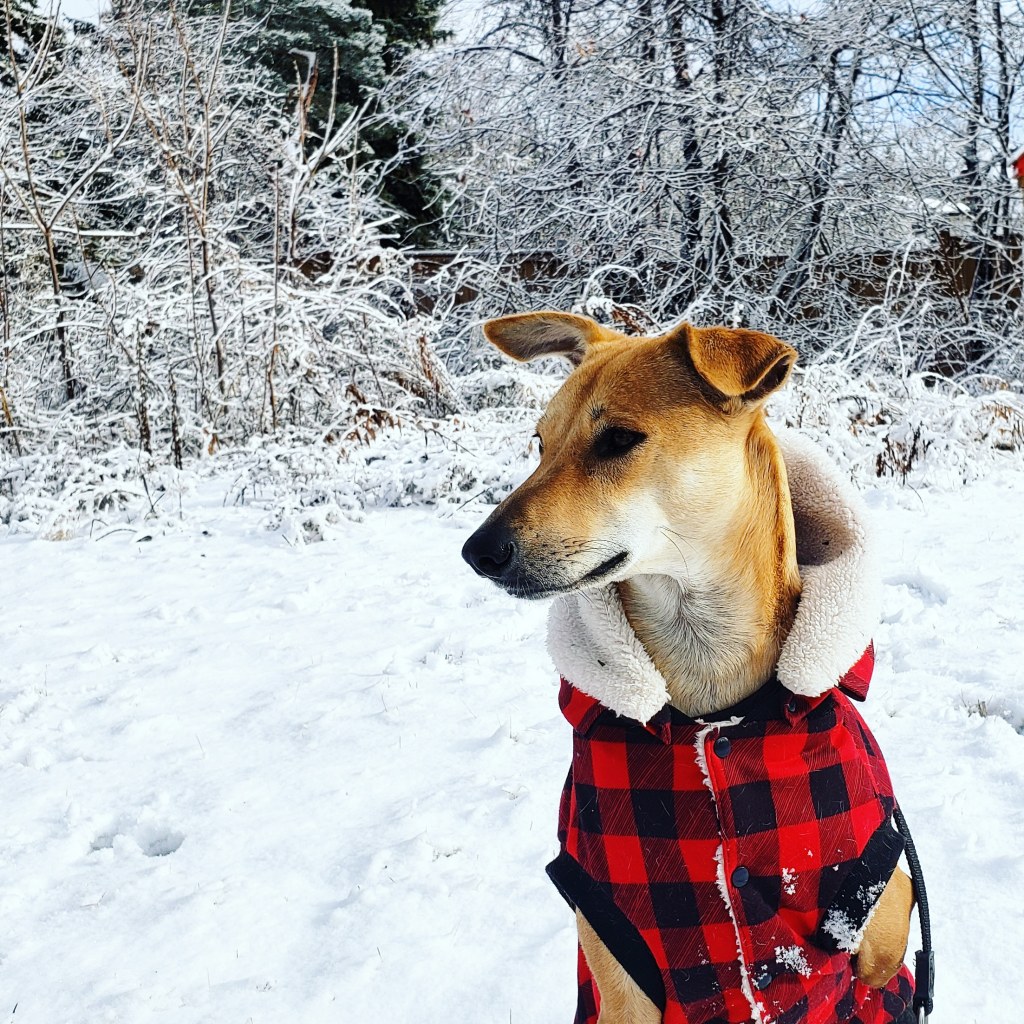
Leo, looking dashing in his fancy winter coat!
Soon it wasn’t just snow he was walking on— Leo showed interest in walking to the end of the street, even though it meant walking on a concrete sidewalk. Once this goal was accomplished, Chanelle set her sights on Leo being able to walk around the entire cul-de-sac.
They started by walking one-third of the way around and slowly increased the distance. Whenever Leo reached his limit, he would sit and whine, which was Chanelle’s signal to pick him up and carry him home.
In about a week, Leo was walking all the way around the cul-de-sac! He can even walk on a leash. Chanelle says it’s so rewarding to watch Leo defy every limitation put on him.
The legs on Leo’s right side of his body have to bear his entire weight. To help him balance, Leo has been shifting his back, left leg to the centre of his body, which can lead to hip problems among other things. Because of this, Chanelle and Justin decided to have a prosthetic back paw made in hopes that Leo would be able to bear some weight on his left side to give him more balance.
To help pay for the approximate $1,500 price tag, they set up a Go Fund Page. Leo has become quite well known on the street, and the community has been very supportive. Chanelle and Justin had decided that regardless of the amount of funds they raised, they were going to get Leo the prosthetic, even if it meant paying for the entire bill themselves.
Happily, the full $1,500 was raised and Leo will soon be getting his prosthetic paw.
Leo patiently getting his prosthetic paw fitted.
It is such a joy to see Leo’s updates on the Fetch & Releash’s Facebook page. I can’t wait to see more videos of Leo as he continues to enjoy his life with his forever family.
When asked if there was one thing she could change in the world, what that would be, Chanelle’s answer—”I wish people would not overlook special needs animals and elderly animals. They’re just as in need of love as a new puppy, sometimes even more loving and grateful! Adopt. Don’t shop!”
To learn more about Leo, follow him on Instagram @leo.the.pariah
It’s amazing how people come into our lives, in what we believe is for a specific purpose, only to become so much more.
I met Marthese Fenech, Mar as she’s known to her friends, in 2015. We were both part of an online writing group called Kidcrit. I quickly realized that Mar was as gifted with her feedback to others as she was with her own writing.
Mar Fenech
Over the years our relationship has grown from sharing a love of writing to sharing a love of animals.
Mar was born in Toronto and now lives north of the city with her husband, Brad, and their beautiful Siberian husky.
Family Photo
She says her love of animals is something that’s innate. She finds animals pure and without artifice. Her maternal grandfather felt the same way. He was known to take care of a pack of stray dogs. The dogs would follow him around Malta, eager for the delicious scraps of food he carried with him.
Mar is also a devoted high school teacher. She has been teaching for twelve years in a variety of subjects including English, World Religions and Phys. Ed.
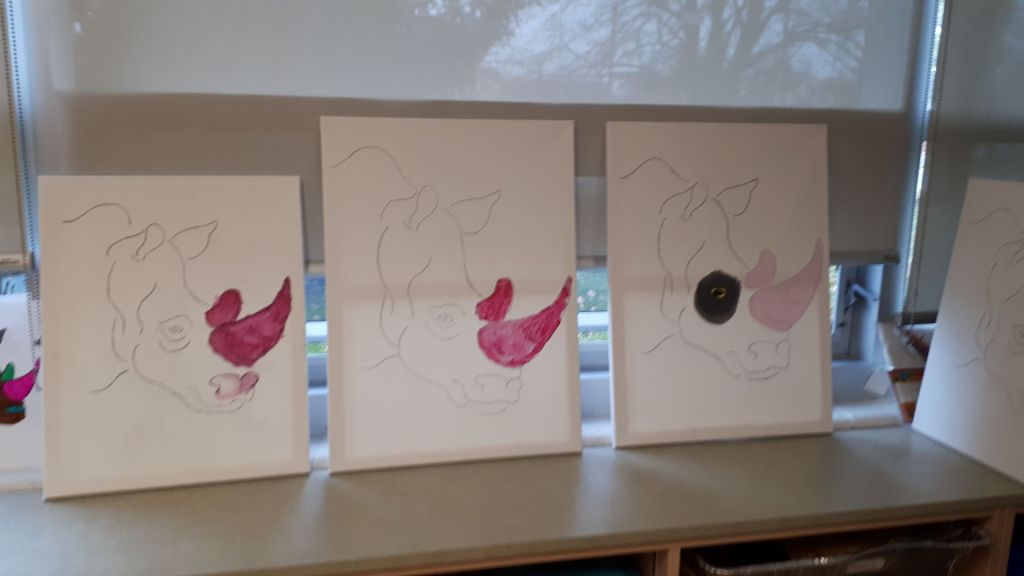
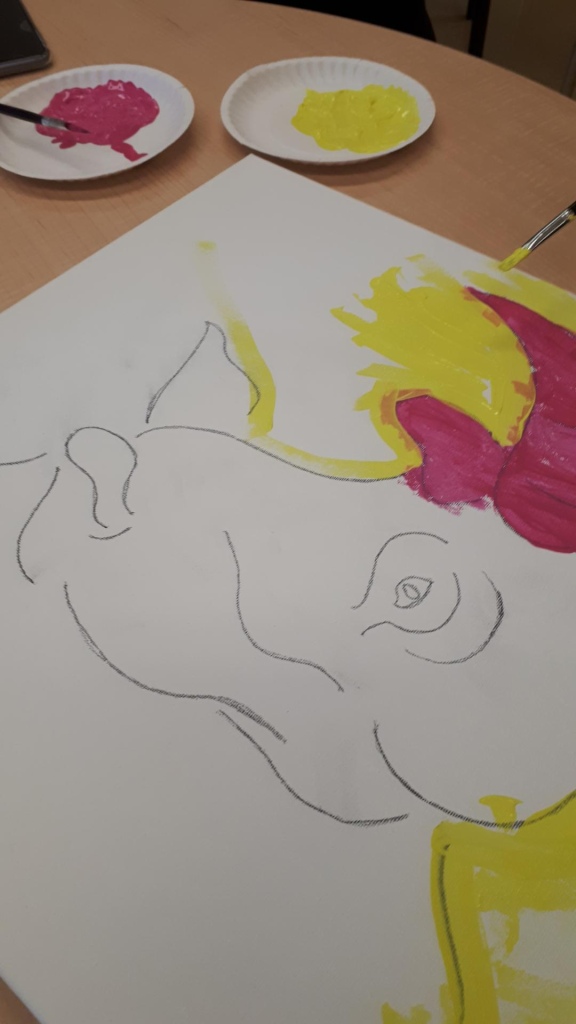
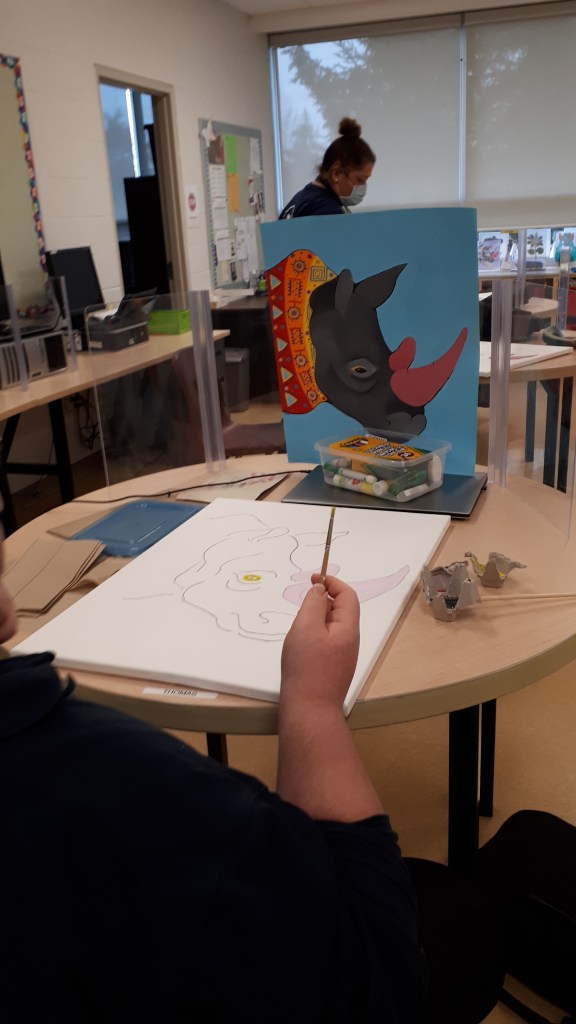
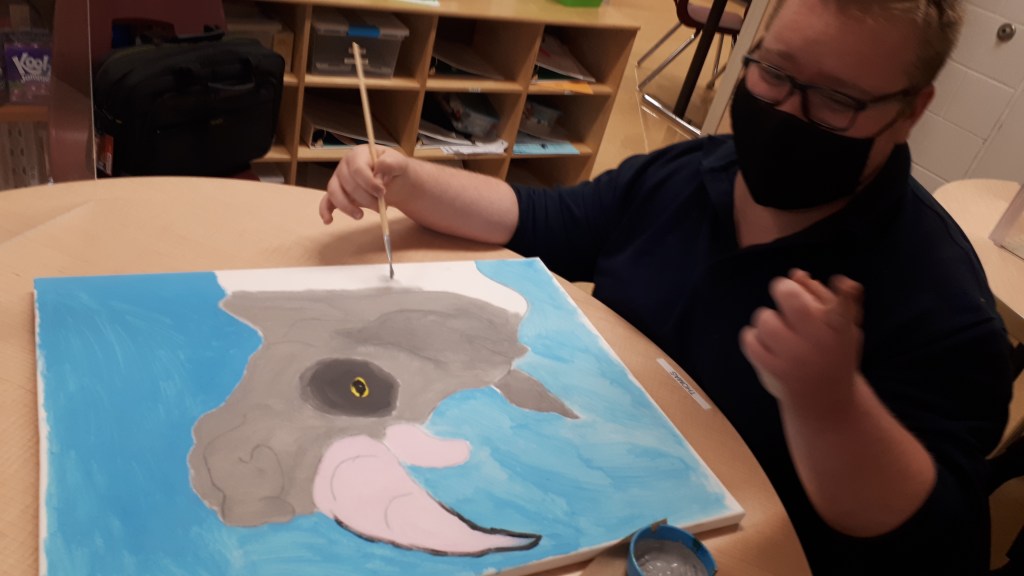
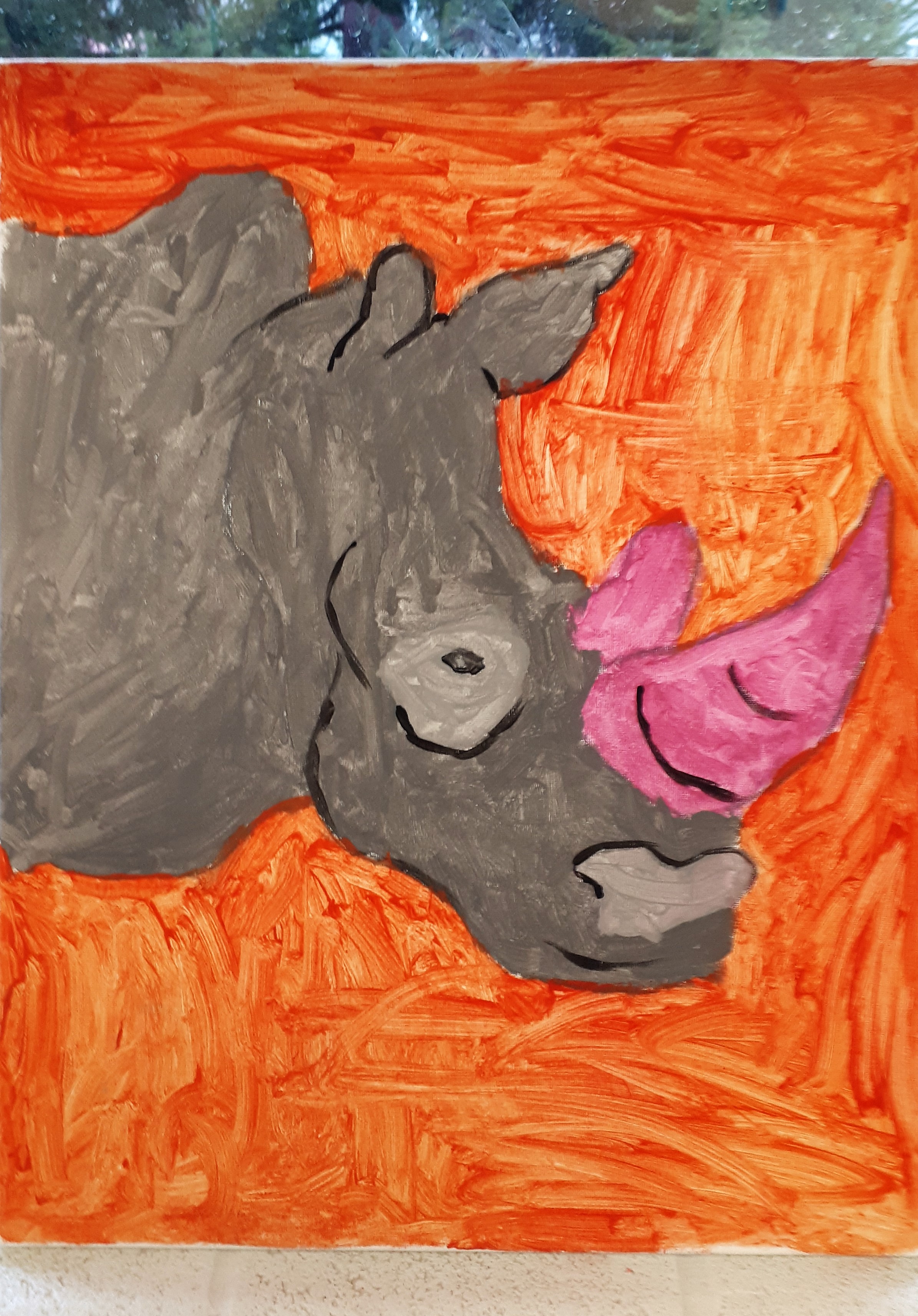
This year, Mar has been teaching a wonderful group of students aged 14-18 with developmental delays and multiple exceptionalities. I was thrilled when she told me that not only was she going to buy a copy of my picture book, A Family For Faru, to read to her class, but the students were going to do an art project based on the book.
Inspiration hit!
I asked if she would be willing to auction the art to raise funds for Care For Wild Rhino Sanctuary, the rhino orphanage my daughter volunteered with. Without hesitation, Mar was on board.
She obtained permission from her Principal, involved teachers from other departments, and began the project!
I loved receiving updates of her students thoroughly engaged in their art. Seeing their happy faces, proudly holding up their gorgeous paintings inspired by A Family For Faru, was incredibly moving.
Once the art was complete, Mar moved onto the next step—auctioning the paintings. Due to the restrictions of Covid-19, the auction was held online. Mar’s wonderfully supportive colleagues at Monsignor Percy Johnson, bid on the artwork. Mar and her amazing students raised almost $500 for the rhinos at Care For Wild Rhino Sanctuary.
But equally, if not more important, Mar instilled a love for other species in her students that they will take with them. She showed them they have the ability to make a positive difference in the lives of animals.
When asked if there was only one thing she could change in the world, what that would be. Her answer— to change humans’ inability to co-exist with each other and other species, a failure borne of human greed, which is at the root of the world’s crises.
I am so very grateful to have met Mar. Her compassion to help others has no bounds. She generously supports other writers, is a devoted teacher to her students and has a great love for animals. It was an absolute honour to collaborate with her on this amazing project to help rhinos.
Many of us have had the privilege of sharing our home with animals. We remember the day we first met them and the great joy and immense love they bring us. Unfortunately, animals don’t live as long as we want or need them to, and eventually we have to say goodbye.
But sometimes an animal outlives their human, and then what happens? Will a relative come forward and care for the dog, cat, rabbit . . .? That is probably the best scenario for the grieving animal—to be taken in by someone they already know.
However, that is not always the case and many animals end up shelters, waiting for another person or family to love again.
This difficult situation happened to Joan Almond back in 2017. She received one of those dreaded phone calls—her brother Brian was in the hospital. Sadly, Brian passed away, leaving behind his beloved cat Tiger. The family not only had to deal with their own loss, but also had to figure out what to do for Tiger.
Tiger
Joan shared her experience with me. Here is her story.
Joan has always loved animals, but like many others, held back from taking on a pet because of the costs and responsibilities. This all changed in 2017 when her brother Brian passed away, just nine months after Joan had lost her mother.
Brian’s celebration of life was packed with friends and family, but there was also someone else represented—a framed photograph of Tiger, Brian’s beloved cat.
Neighbours and friends chipped in and helped take care of Tiger for the first couple of weeks after Brian’s passing. But a more permanent solution was needed.
“I’m taking him!” Joan said without thinking.
“Cat hair!” an older sister said.
“I don’t care!” Joan said. “I want him!”
As Joan drove home with Tiger crying in the back seat, she thought, “What did I get myself into?”
That night, Tiger slept at the end of Joan’s bed, on his favourite blanket.
There were adjustments, like the 5am wake up time, lots of scratched furniture and the cost of taking on a pet—vet bills, grooming, boarding, litter, and food.
Regardless, Joan says Tiger is her Best Bud, even though, like most family members, he does frustrate her somedays.
Joan has learned so much from Tiger, including how to share space, how lovely it is to be greeted at the door when she comes home, and of course what it means to be loved unconditionally.
Joan, like many of us who welcome animals into our homes, often wonder who adopted whom.
I asked Joan if there is one thing she could change about the world, what would it be? Joan’s answer—That we humans learn to love, like Tiger does- unconditionally – not caring what we look like or what the colour of our skin is – what we’re wearing, or how much money we have- or even how successful we are – forgiving each other when we step on each other’s tail (accidentally.)
One of my favourite parts about this blog, is connecting with people who use their skills or talents to help others. Eric Walters is a prime example of such a person.
Eric was born in Toronto, Canada in 1957. He went on to become a social worker and then in 1992 earned his teaching degree. It was his experiences as a teacher that first drew him into writing.
In 1993 when Eric was teaching a Grade 5 class, he realized many of his students were what he calls “reluctant readers and writers”. In an effort to instil them with a love or at least a willingness to read and write, Eric wrote his first novel, Stand Your Ground. The story was set in the school where Eric taught and many of the characters were named after his students. He hoped by making the story personal and relatable to his students, they would be encouraged to read it.
Eric’s grade 5 class picture – He’s in the 2nd row from the top, 3rd from the left. His teacher was Miss Gay. She’s the person who told him he could be a writer when he grew up.
Miss Gay & Eric at the ‘book launch’ of Fourth Dimension. She was invited but actually it was a surprise 93rd birthday party for her!
Cover of Eric’s first book, Stand Your Ground
He was right! His plan was a success and thus began Eric’s career as a writer.
In 2006, Eric transitioned from full-time teacher to full-time writer. To date, he has published 111 novels and picture books. He has won more than 100 awards for his writing, and in 2015 he received the Order of Canada for his contributions to literacy and social justice.
Eric receiving the Order of Canada
Eric’s novels are available throughout the world: New Zealand, Australia, India and Nepal. He is what some might call a workaholic—although Eric would say, “that when you love what you’re doing it’s never really work.” In addition to finding time to write, Eric manages to do approximately 500 presentations in schools and libraries each year. So far, he has presented to more than 1,800,000 students across North America and internationally in Japan, Kenya and Germany.
Cover of Eric’s latest book, Don’t Stand So Close To Me(Orca, 2020)
Cover of The King of Jam Sandwiches – a semi-autobiography to be released September 2020 by Orca Book Publishers
Most people would find it difficult to maintain this schedule, but Eric found a way to fit in even more.
In 2007, Eric and his son travelled to Kenya to visit with the family of a close Kenyan, Canadian friend. This trip lead to a chance meeting with a young orphan boy – Mutuku – in the marketplace of Kikima, Kenya. Eric discovered that Mutuku was one of more than 500 orphans spread across the Mbooni district in rural Kenya.
Eric’s wife, Anita, with Mutuku
Kenya has the fourth largest HIV epidemic in the world. The disease has devastated the population, leaving behind approximately 1.1 million orphans; far too many to live in the existing number of orphanages. Thus, many orphans are homeless and forced to live in the streets.
Eric wanted to help Mutuku and discovered the best way would be to pay for the boy to be taken in by an orphanage.
Once Mutuku was settled into a proper orphanage, Eric wanted to help more orphans. And he did exactly that!
Eric, along with his wife and friends, Ruth and Henry Kyatha, founded the Creation of Hope in 2008.
Anita with Ruth to her right
Hope currently supports close to 200 orphans as well as indirectly helping hundreds of other impoverished children throughout the area.
Birthday party for the orphans and celebrating Today Is The Day
A little girl named April. A midwife, who HOPE brought over, saved her at birth
Support is provided in the following ways:
Food Distribution.
Many of the orphaned children within the program still live with their guardian families like their aunts, uncles or grandparents. Food distribution allows children to remain in their homestead with their loved ones and ensures they and their family are receiving food. Whenever possible, Creation of Hope tries to keep children within their own homestead as to not take them away from their community, school and family. Monthly distributions of food give families the opportunity to function independently.
Water Projects.
Providing food is necessary to avoid starvation. However, providing a source of water, could prevent the risk of starvation from arising at all.
Creation of Hope has formed partnerships with communities to create water projects. The charity provides many of the supplies and outside expertise, and the community provides supplies such as sand and gravel, as well as labour. The projects are overseen by a local committee.
Opening a new water project!
This partnership means that community members are not only invested in the project but are intimately involved with how to maintain the project. If there are problems that evolve, they have the expertise and the ownership to fix it. In addition, labourers are paid a fair wage for their contributions.
The Rolling Hills Residence
In 2019, Creation of Hope built The Rolling Hills Residence. It is now home to 79 orphans. These are children who have lost both parents and also have no one within the community who is able to provide support.
There are four separate dormitory rooms in the residence – younger boys, older boys, younger girls and older girls – and a large dining hall, study and gathering area. Additionally, the residence has a large kitchen which has one of the very few ovens in the entire region. They produce cakes, breads, and muffins which are sold to local stores and schools to provide additional income for the project.
The Rolling Hills Residence
Another unique feature is a community conference room which can be rented out, or used by Hope staff.
All materials to build the residence, wherever possible, came from community sources. This includes locally manufactured bricks, quarried stone, fabricated metals, furniture made in Kikima, and local trees with a replant program to avoid deforestation.
During the almost three years of residence construction, Hope was one of the largest local employers. Hope continues to value and utilize local resources, materials and labour to benefit the community and its people.
Mattress delivery!
Creation of Hope sees itself as more than a charity. It is an opportunity; a way to invest in the future of these children, their community, and ideally Kenya as a whole. The program is run “on the ground.” Decisions are made by a local board of directors. While Eric and his wife are members of the board, they are only two voices on a committee of twelve. The community has embraced the program, and in some years, almost half of the funds come from Kenyan sources.
When I asked Eric about his foundation, he was very humble and made a point of talking about the contributions of others. But when he spoke about the children and their successes, his voice shined with pride.
Willy, one of the many graduates and one of Eric’s favourite kids
Currently, they are 79 children residing in the main building, receiving food, shelter and education. There are a further 64 children/young adults in high school, college and university, also supported by Hope.
Since the project began, 44 people from the Hope project have graduated from post-secondary education and have gone on to become teachers, hair dressers, carpenters, electricians, auto mechanics, business people, a research assistant, an IT specialist, and a banker.
Eric, celebrating with some of HOPE’s trade school graduates.
Some of HOPE’s college and university graduates.
One of the most gratifying parts of this foundation must be watching the graduates return to the residence and take on roles of mentoring and tutoring the other children. The graduates give back to the program that gave them a chance to fulfill their dreams and ambitions. Eric says the charity will financially support the children for as long as they need.
Two of HOPE’s college graduates who married and had a baby. Traditional Kamba is to name first male after paternal grandfather. As they had no fathers, they asked Eric if they could name their baby Hope as Hope has been their parent.
The first child in the program, Mutuku, was also one of the first graduates. He received a business diploma from a college, but went back to his ‘calling.’ Mutuku has created an academy and church, where he is the director and pastor. His inspirational story of being abandoned, orphaned and living in a garbage dump to where he is now and what he has achieved, lifts many spirits.
Eric and Mutuku
Mutuku proudly standing in front of his building
Eric and his wife, Anita are major contributor to the charity. They personally donate their own money in addition to Eric securing donations from the hundreds of schools he visits each year. However, the pandemic has prevented Eric from visiting schools and thus donations have fallen.
Unfortunately, like so many charities, Creation of Hope has suffered due to the Covid-19 Pandemic. There has been a drop in donations from schools, and several other donors and sponsors have also had to back out due to their own financial hardships.
Eric is working hard to secure more sponsors and donors. The children are counting on him and he is committed to helping them.
The children always make thank you signs for all the donations
He is grateful for the on-going support from sponsors in Canada and the United States. In particular, he would like to thank the people in the writing community for their continued dedication to help these children. People such as: Teresa Toten, Natasha Deen, Lorna Nicholson, Deb Ellis, Valerie Sherrard, Carol Matas, Margriet Ruurs, as well as regular contributions from Martha Martin and Marina Cohen. Eric would also like to thank Amy Black of Penguin Random House and Andrew Wooldridge of Orca Book Publishers for their sponsorships. Plus, a special note of appreciation to Penguin Random House and their on-going donations related to Eric’s novel, Walking Home.
If you would like to learn more about Eric’s books, Creation of Hope and how you can help, please visit his website at http://www.ericwalters.net/
One of the great joys in creating this blog post is hearing how these stories of kindness touch and inspire others. I was incredibly heart-warmed when Marilyn Helmer, who had already shared her story, Random Acts of Kindness, told me she enjoyed reading one of my other posts.
As a dedicated cat lover, Marilyn was particularly taken by the post titled, Kate and Her Cats.
“Although I haven’t had anywhere near the number of cats Kate has had, I can certainly relate to her love for them. I particularly enjoyed her story about raising the young kittens”
In 2003, Marilyn was blessed with the opportunity to rear a litter of abandoned kittens her son rescued from inside an air conditioning vent. Chris and his girlfriend brought them home for Marilyn to raise. With the help of her daughter, Sandra, also a devoted cat lover, and advice from the animal clinic where Sandra was working for the summer, all four babies survived and thrived.
Marilyn was delighted to have her story published in Chicken Soup for the Soul in 2017. With their permission, Marilyn shares that story here for us to enjoy!
Unexpected Visitors
by
Marilyn Helmer
(originally published in Chicken Soup for the Soul—The Cat Really Did That?)
The phone rang while I was busy preparing dinner.
“Hi, Mom, we’re heading home now.” It was my son Chris. He and his friend Jenn had been out of town the day before.
“Great,” I replied. “We’ll expect you in a couple of hours.”
“Wait, Mom, I have something to tell you.” Just then my oven timer dinged.
“Tell me when you get here,” I said. “Pie’s ready. Got to go.”
As I started to hang up, I heard Chris say, “We’re bringing some extra company.”
Extra company? Yikes! Would there be enough food to go around? “How many?” I asked.
“Four,” said Chris.
“Four? Chris, I can’t feed four extra people on such short notice!”
“Good news, Mom,” he replied cheerfully. “You don’t have to feed people. The company I’m bringing home is four abandoned kittens.”
“Kittens? Chris…”
“We’re stopping at Sandra’s on the way. She’s getting formula for them.” My animal-loving daughter had a summer job at the local veterinary clinic. “They’ll have to be fed every four hours. Don’t worry, she’ll explain it all to you.”
“Explain? Explain what?” Too late. Chris had hung up.
The timer dinged again. My pie! I yanked the oven door open to a burned-apple smell. Too late for the pie too.
I made a cup of tea to calm my nerves and phoned Sandra.
“What’s up?” she asked.
“Apparently four newborn kittens,” I replied.
“Don’t worry, Mom. I got the formula and bottles. The vet said they’ll have to be fed every four hours. I’ll come and show you what to do.”
Show me what to do? “Sandra, I don’t know anything about caring for newborn kittens.”
“I’ll help,” she said. “But I work all day so I can’t look after them full time.”
And I don’t work all day? I’m a writer. Writers work day and night. Well, sometimes.
“I have to go,” Sandra broke in. “Chris and Jenn just arrived. See you soon.”
I love animals passionately but being caregiver to four newborn kittens was more than I could handle. I resolved then and there to follow that sage advice, “Just say no.”
I was working on it when the front door opened. “Mom? Come see the kittens,” Chris called from the vestibule.
I went downstairs, silently repeating the “Just say no.” mantra.
In a basket in Jenn’s arms lay four tiny kittens, snuggled together.
(l-r) Chloe, Zoli, Leo & Bailey
“Where did you find them?” I asked.
“We heard cries coming from the roof of our motel,” Jenn said.
“The guy in the office said a pregnant cat had been hanging around,” Chris jumped in. “He kept chasing her away but he thought she’d had her kittens on the roof.”
“He said he hadn’t seen her for several days so he figured she’d been killed on the highway and now he was stuck dealing with them. We knew what he meant by dealing with them,” Jenn said ominously.
“I told him we’d look after them,” Chris said. “I borrowed his ladder and got up on the roof. Somehow the mother cat managed to get inside the air conditioning unit and had her kittens there. She must have been desperate and thought it was a safe place.”
I quickly blocked out the thought of what might have happened to the kittens if Chris and Jenn hadn’t come along.
At that moment, the smallest kitten gave a faint squeal. Before I knew what I was doing, I reached in and picked it up.
Leo & Bailey
“He’s the runt of the litter,” Jenn said. “He may not survive.”
“Unless he has the best care possible,” Chris added. “Care only a mother can give.”
“I am not a mother cat,” I reminded my son as I wrapped my sweater gently around the unbelievably tiny bit of life in my hands.
The door opened and Sandra came in. Her eyes went to the sweater-wrapped bundle in my arms. I didn’t miss the knowing smile she, Chris and Jenn exchanged.
“I brought everything you’ll need for the kittens – formula, feeding bottles, wipes,” Sandra rhymed off. “We’ll work out a schedule and we’ll all help. Mom, look at them.” She picked up the white one with orange and black markings. The kitten obligingly wobbled her head and managed to look sweet and pathetic at the same time. “How can you resist?”
The bottom line was, I couldn’t.
In no time the kittens were awake, filling the house with their hungry chorus. My “Just say no.” mantra vanished in the twitch of a whisker.
That afternoon, Sandra walked me through the steps of kitten care. “They have to be fed every four hours. Then there’s the toileting.” I won’t go into details but suffice it to say disposable diapers do not work on kittens.
And so I became a kitty mama. If I thought my children had been messy eaters, the kittens outdid them, hands…er… paws down. And bathing a kitten is no easy job. Imagine a body so small that it fits into the palm of your hand, with twig-like limbs and paws the size of a dime. Imagine toweling them dry, taking care not get tiny claws snagged in the cloth.
When I was on my own that night for the ten o’clock feeding, reality hit. There were four of them and only one of me. When one kitten woke up, its hungry cries woke the others. Suddenly I had four little pink mouths emitting heart-rending pleas. Begging the one I was busy feeding to hurry so the others could have their turn fell on deaf ears. Last but not least, every towel and blanket that lined their basket had to be washed because no one was toilet trained.
Fortunately, as the days went by, I did have help. On alternate days, Sandra took the kittens to the veterinary clinic where the staff argued over who would get look after the adorable quartet. Strangely no one offered to do the night shifts though.
As well as feeding the kittens on schedule, we had to keep track of every gram of formula they drank. I couldn’t bear to list them as Kitten 1, 2, 3 and 4 so I named them – Bailey, Zoli, Chloe and for the littlest one, the biggest name of all – Leo the Lion-hearted.
Chloe, Bailey, Zoli & Leo
Once named, the kittens developed individual personalities overnight. Leo certainly lived up to his name. His heart stopped twice, thankfully when he was in my daughter’s care. Using two fingers, for that was all that would fit on his tiny chest, Sandra managed to massage his heart back into action.
Good news! They all survived and thrived. Zoli and Bailey were adopted by Sandra’s mother-in-law where they are presently living a life of leisure. Chloe went to live with a friend of Chris’s and wee Leo was adopted by a client at the veterinary clinic.
Seventeen years have passed since those four unexpected visitors arrived. Looking back, I am thankful beyond measure that I had the opportunity to play a part in their survival and to observe up close, the miracle of life.
Zoli & Bailey, 17 years old & living the life of luxury
If you would like to learn more about Marilyn and the wonderful stories she creates, please check out her website at http://marilynhelmer.com/
A while back, I reached out to my writing community in hopes some people would share their stories of kindness with me. I was so happy to receive this story from author Marilyn Helmer.
I feel this story is particularly relevant as we deal with the reality of living through a world-wide pandemic. Though many who are infected with Covid-19 recover, the virus can be deadly to the elderly and those who are immunocompromised. As a result, many hospitals and nursing homes are no longer allowing visitors. This restriction has been implemented to save lives, but that doesn’t mean it is void of any hardships. Patients, residents and their families must miss being able to see each other.
Marilyn’s story is a reminder of how important kindness and human interaction is for those living in nursing homes.
I asked Marilyn if there was one thing in the world she could change what would it be. Her response: I’m not sure that this can be considered an actual change, but my wish would be simply what I said at the end of my story – that people would become more aware of the blessings of simple acts of kindness, for both the receiver and the giver.
Here is Marilyn’s story, in her own words. I hope you enjoy it, and I hope soon families will once again be able to visit their loved ones.
Front row (l-r) Sandra (Marilyn’s daughter), Marilyn’s mom, Chris (Marilyn’s son). Back row- Marilyn
If you would like to learn more about Marilyn and the books she writes, check out her website at http://www.marilynhelmer.com
Random Acts of Kindness
by
Marilyn Helmer
Years ago, when my mom moved into a nursing home, I visited her two or three times a week. During these visits, I got to know some of the other residents. This was a blessing, because it gave me the opportunity to see how even small, unintentional acts of kindness can bring joy to people who do not have a lot to look forward to.
The first Christmas Mom was in the nursing home, we brought her home to celebrate Christmas with the family. A few weeks ahead of time, visitors were asked to consider contributing a small gift for residents who would not be going home for Christmas due to dementia or family who lived too far away or simply weren’t interested in visiting. I asked Gina, the head nurse, for gift suggestions. To my surprise, one of the items she suggested was a stuffed toy. She said sometimes people with advanced dementia would relate to something they could cuddle.
Marilyn & her mom-Christmas 1990
When I was shopping a few days later, a particularly adorable teddy bear caught my eye. I hesitated, wondering if a teddy bear really would appeal to an adult. Then again, it had appealed to me, hadn’t it? I bought the teddy bear and donated it. Shortly after Christmas, Gina told me that the lady they gave it to suffered from advanced dementia and rarely communicated at all. When they gave her the teddy bear though, she put her arms around it and said, “Oh, my Christmas bear!” She still had the teddy bear when she passed away a few months later.
Another resident, Lorna, was fifty-five years old and wheelchair bound. Lorna suffered from physical and mental challenges so she couldn’t live on her own. Her family lived far away and no one ever came to see her.
When I visited, I always stopped at a nearby Tim Hortons to pick up a coffee for Mom and myself. Our routine was to take the coffee and cookies to the Social room, a bright, cheerful room that was usually empty. One day, Lorna wheeled herself in and joined us. She noticed the coffee Mom and I were drinking and asked me where I had gotten it. When I told her Tim Hortons, she said, “I love Timmies’ coffee but I can’t get there myself. The next time you come in, bring one for me too. Make it a double/double.”
I later mentioned this to one of the nurses. She rolled her eyes and said, “Lorna asks everyone who visits to bring her a coffee from Tim’s but she doesn’t have any money to pay for it. Just ignore it. She’ll forget she ever asked you.”
Marilyn’s mom and two of her mother’s favourite caregivers
The next time I stopped at Tim Horton’s, I remembered Lorna’s request. It was such a simple request and I was already there, buying coffee for Mom and myself. It didn’t take any extra time or effort to order another double/double. I remember that first time I did it. Lorna was delighted when I handed her the coffee but when she took the first sip she told me that it was cold. “Take it to the kitchen and have them warm it up,” she said. She rarely said thank you but Gina later told me that Lorna often asked her, “Where is that sweet young thing who brings me the free coffee from Tim’s?” Actually I was a few years older than Lorna at the time.
My mom’s roommate, Sylvie, was a warm, cheerful person whose only issue was mobility. Her husband, who also had mobility issues, visited her as often as he could. Sylvie took my quiet mother under her wing, chatting with her and reading to her. She told me that although Mom rarely responded, she smiled a lot so Sylvie knew that she was happy. As well, Sylvie gave me a full report on how Mom was doing and what she had eaten each time I came in.
One thing my mom really enjoyed were cookies from Marks & Spencer. I made sure to keep a tin in her room to have with our coffee whenever I came in. One day Gina took me aside and told me that I should start hiding Mom’s cookies because she had caught Sylvie and her husband “feasting” on them a couple of times when he visited.
I told Gina that as long as the cookies weren’t harmful diet-wise to Sylvie or her husband, just let them enjoy them. Cookies were such a small reward for the kindness and attention Sylvie gave my mom when I wasn’t there.
Marilyn and her mom in 1998 celebrating her mother’s 90th Birthday
Another resident, ninety-nine years old Gord, was an amazingly with-it man who looked forward to chatting with my husband when he came with me to visit Mom. Gord had all his mental faculties about him. As soon as he spotted my husband, Gord made a beeline for the Social room to chat with him. Gord had been through two wars and had fascinating stories to tell. All he needed was someone to listen.
The Random Acts of Kindness Day was created in the United States in 1995. Since then, it has grown in popularity, making us aware that kindness can be shown in many ways. The acts don’t have to be time-consuming or of great importance. Things as simple as a smile, a kind word or a cheerful greeting can brighten someone’s day
Time is one of the most valuable commodities we have. To share our time with someone who needs it doubles the value of our time. One of the greatest rewards in life is knowing that you have done something, no matter how small, to bring joy into someone else’s life. Random acts of kindness are a gift, both to the receiver and to the giver.